Workshop Scope
Medical imaging has long relied on discrete, grid-based representations that impose artificial constraints on inherently continuous anatomical structures. This workshop aims to explore "off-grid" approaches, from Implicit Neural Representations to Gaussian Splats, ultimately advancing medical image computing and computer assisted intervention.
Topics of Interest
We welcome submissions on a wide range of "off-grid" methods, including but not limited to:
Neural fields and implicit neural representations for encoding MRI, CT, X-ray, ultrasound, pathology images, endoscopy, and other medical signals
NeRFs, Gaussian Splatting, and related techniques for 2D/3D/4D visualization, novel view synthesis, and surface/volume reconstruction of anatomical structures
Generalization approaches including autodecoders, hypernetworks, or meta-learning strategies
Neural compression strategies using implicit representations for high-fidelity storage and transmission of large-scale medical imaging datasets
Methods leveraging continuous representations for super-resolution, cross-resolution learning, and handling heterogeneous acquisition protocols
Continuous deformation fields and grid-free approaches for image registration across modalities, time points, respiratory/cardiac phases, or subjects
Implicit surface representations and splat-based methods for anatomical structure segmentation and shape completion
Real-time rendering, scene reconstruction, and visualization for surgical planning and navigation
Diffusion models, GANs, and other generative approaches combined with continuous representations for synthetic medical data generation
Methods for estimating uncertainty in INRs, NeRFs, and Gaussian Splatting for safer deployment in clinical workflows
Fourier Neural Operators, DeepONets, and related architectures for learning resolution-independent mappings for reconstruction, super-resolution, and inverse problems
PINNs and their application to solving partial differential equations and parameter estimation in medical imaging
Important Dates
All deadlines are 23:59 Anywhere on Earth (AoE).
Workshop Program
The workshop will be held as a half-day session. 24 papers were accepted for presentation: all 24 will be presented as posters, with 8 of them additionally selected for oral talks. Select a session in the schedule below to see its papers.
| Time (Local Time, GMT+2) | Activity |
|---|---|
| 1:30 PM - 1:45 PM | Opening Remarks |
| 1:45 PM - 2:30 PM | |
|
#9
Learning Cardiac Motion Priors for Implicit Neural Representations
Andrew Bell, George Webber, Steffen E. Petersen, Andrew P. King, Muhummad Sohaib Nazir, Alistair Young
#12
From Histology to in vivo MRI: An Implicit Neural Representation Framework for Medial Temporal Lobe Subregion Segmentation
Yue Li, Amanda E. Denning, Zahra Khodakarami, Pulkit Khandelwal, Long Xie, Christopher A. Brown, Laura E. M. Wisse, Sandhitsu R. Das, David A. Wolk, Paul A. Yushkevich
#14
INR-based FPCA for Efficient Analysis of Longitudinal Neuroimaging Data
Matthias Wilms, Agampreet Aulakh
#30
The Right Prior for the Right Deformation: Rethinking Continuous Deformable Image Registration
Hengjie Liu, Chushu Shen, Dan Ruan, Ke Sheng
|
|
| 2:30 PM - 3:30 PM | |
|
#3
4D Triangle Splatting Reconstruction of Dynamic Endoscopic Scenes from Monocular Videos
Laura Salort-Benejam, Stamatia Giannarou, Antonio Agudo
#4
Neural CDEs for Variable-Length qMRI: IVIM and R2* Estimation in the Pancreas
Florent Tachenne, Marie Pelissier-Combescure, Kpegouni Fadel, Chad Estoup-Streiff, Charles Berger, Marion Tardieu, Olivier Riou, Stephanie Nougaret
#7
Causal Spatio-Temporal Neural Distance Fields for Counterfactual Cardiac Anatomy
Mathias Lowes, Kurt Butler, Kristine Aavild Sørensen, Klaus Fuglsang Kofoed, Sotirios A. Tsaftaris, Rasmus Reinhold Paulsen, Steven McDonagh
#9
Learning Cardiac Motion Priors for Implicit Neural Representations
Andrew Bell, George Webber, Steffen E. Petersen, Andrew P. King, Muhummad Sohaib Nazir, Alistair Young
#11
Overlap-Free Multi-Organ Shape Synthesis with Implicit Neural Representations
Bram de Wilde, Max Rietberg, Alina Dima, Joëlle van Aalst, Guillaume Lajoinie, Jelmer M. Wolterink
#12
From Histology to in vivo MRI: An Implicit Neural Representation Framework for Medial Temporal Lobe Subregion Segmentation
Yue Li, Amanda E. Denning, Zahra Khodakarami, Pulkit Khandelwal, Long Xie, Christopher A. Brown, Laura E. M. Wisse, Sandhitsu R. Das, David A. Wolk, Paul A. Yushkevich
#14
INR-based FPCA for Efficient Analysis of Longitudinal Neuroimaging Data
Matthias Wilms, Agampreet Aulakh
#16
Shape-guided Gaussian Splatting for Sparse-View X-ray 3D Reconstruction
Pranav Poudel, Florence Dell'Aniello Picard, Nairouz Shehata, Frédéric Lavoie, Herve Lombaert
#20
Modelling Geographic Atrophy Progression using Implicit Neural Representations
Simone Sarrocco, Paul Friedrich, Florentin Bieder, Christina Bornberg, Philippe Valmaggia, Peter M. Maloca, Philippe C. Cattin
#24
Strain Rate Estimation from Ultrasound Channel Data
Vincent van de Schaft, Ruud van Sloun
#25
NIMOSEF-R: Neural Implicit Motion and Segmentation Functions with Riemannian Embedding Priors and Breath-Motion Correction
Gonçalo Canastra, Jaume Banus, Van Heeswijk Ruud, Jonas Richiardi
#26
Hemodynamic Neural Field: Continuous Blood Flow Estimation in Vessel Geometries via Global Shape Conditioning
Simon Perrin, Patryk Rygiel, Amin Ranem, Bram de Wilde, Sébastien Levilly, Jelmer M. Wolterink, Harold Mouchère
#28
Primitive Representation Learning for Unsupervised Dynamic Contrast Enhanced MRI Reconstruction
Veronika Spieker, Wenqi Huang, Cemre Ariyurek, Liam Timms, Daniel Rueckert, Onur Afacan, Julia Schnabel, Sila Kurugol
#29
Surface-Conditioned Implicit Reconstruction of Internal Anatomy for Automated Patient Positioning
Denis Krnjaca, Mattias P Heinrich
#30
The Right Prior for the Right Deformation: Rethinking Continuous Deformable Image Registration
Hengjie Liu, Chushu Shen, Dan Ruan, Ke Sheng
#31
Piecewise Positional Encodings (PPE) for Medical Image Representation
Anusha Kanagala, Stephanie Marie Aguilera, Dhiral Panjwani, Abhiraj S. Pudhota, Sandeep Bodduluri
#32
Implicit representations are dead. Long live explicit primitives!
Nil Stolt-Ansó, Maik Dannecker, Wenqi Huang, Andras Jakab, Daniel Rueckert
#33
Over-parameterising optimisation for sparse 3D medical image registration
Mattias P Heinrich
#34
K-NeAS: Scalable Multi-Material CT Reconstruction Using Neural SDFs
Daksh Kalpesh Shah, Emmanouil Nikolakakis, Razvan Marinescu
#35
Is Reconstruction Fidelity a Reliable Proxy for Segmentation in Medical INRs?
François Lecomte, Frédérick Roy, Jaesoon Choi, Stephane Cotin
#36
Neural Field Fourier Token Mixers for Medical Image Segmentation
Niels Vyncke, Pooya Ashtari, Aleksandra Pizurica
#37
Mirror and Map: Symmetric Latent Deformation Priors for Deformable Image Registration using Implicit Neural Representations
Bennet Kahrs, Fenja Falta, Jan Ehrhardt, Heinz Handels, Timo Kepp
#38
Probing implicit neural representations for biomedical image classification in weight space
Michal Byra, Agnieszka Pregowska, Janusz Szczepanski
#41
Observation-Conditioned Latent Energy Priors for Sparse Implicit Neural Shape Completion
Paul Büschl, Ezequiel De la Rosa, Julia Wolleb, Julian McGinnis, César Nombela-Arrieta, Bjoern Menze
|
|
| 3:30 PM - 4:00 PM | Coffee Break |
| 4:00 PM - 4:45 PM | Keynote Lecture by Prof. Guha Balakrishnan |
| 4:45 PM - 5:30 PM | |
|
#16
Shape-guided Gaussian Splatting for Sparse-View X-ray 3D Reconstruction
Pranav Poudel, Florence Dell'Aniello Picard, Nairouz Shehata, Frédéric Lavoie, Herve Lombaert
#26
Hemodynamic Neural Field: Continuous Blood Flow Estimation in Vessel Geometries via Global Shape Conditioning
Simon Perrin, Patryk Rygiel, Amin Ranem, Bram de Wilde, Sébastien Levilly, Jelmer M. Wolterink, Harold Mouchère
#33
Over-parameterising optimisation for sparse 3D medical image registration
Mattias P Heinrich
#34
K-NeAS: Scalable Multi-Material CT Reconstruction Using Neural SDFs
Daksh Kalpesh Shah, Emmanouil Nikolakakis, Razvan Marinescu
|
|
| 5:30 PM - 6:00 PM | Award Ceremony and Closing Remarks |
Awards
Keynote Speaker
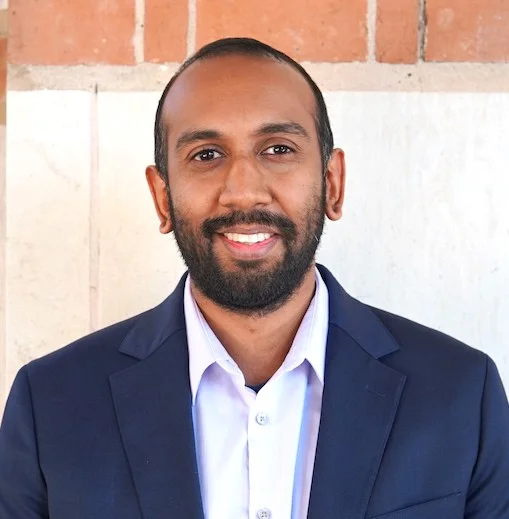
Prof. Guha Balakrishnan, PhD
Rice University
Talk: Learning Through Fitting: Advancing Non-Pixel Representations for Visual Inference
Bio: Guha Balakrishnan is an Assistant Professor in the Electrical and Computer Engineering Department at Rice University. His research group tackles a diverse range of problems across computer vision and imaging, with a primary focus on developing efficient neural representations for complex visual signals and advancing responsible AI through uncertainty estimation and interpretability techniques. He frequently grounds these methods in real-world applications by collaborating with domain experts in scientific disciplines such as medicine and the geosciences. His scientific contributions have been recognized with several honors, including the NSF CAREER Award and the MICCAI Best Paper Award. Before joining Rice, he completed his Ph.D. at MIT’s Computer Science and Artificial Intelligence Laboratory (CSAIL), and earned his undergraduate degrees in Computer Science and Computer Engineering from the University of Michigan, Ann Arbor.
Submission Guidelines
Paper Format
- We accept full paper submissions: 8 pages (excluding references, acknowledgments, disclosure of interests) + 2 additional pages for references, acknowledgments and disclosure of interests
- All papers must follow the official MICCAI 2026 Paper Submission Guidelines
- Papers must be formatted using the official MICCAI 2026 LNCS Template
- All submitted material must be properly anonymized for the double-blind review process. Omit acknowledgments and disclosure of interests from submitted manuscripts; include them only in the camera-ready version
- See the Avoiding Desk Rejection guide before submitting
- Supplementary materials are limited to multimedia content (e.g., videos) as warranted by the technical application. PDF files may not be submitted as supplementary materials unless authors are citing a paper that has not yet been published. In such a case, authors are required to submit an anonymized version of the cited paper
- We encourage authors to submit anonymized code alongside their paper (e.g., via AnonymousGitHub)
Originality
All submissions must be entirely original and should not overlap substantially with any work already published or under review. Likewise, no paper with overlapping content may be submitted to another conference, journal, or workshop during the review period (with the explicit exception of preprint servers like arXiv, bioRxiv, MedRxiv, or TechRxiv).
Review Process
Each submission will be reviewed by at least three members of the program committee. We will use OpenReview for the review process, and will publish anonymized reviews and meta-reviews. Reviews will evaluate technical quality, novelty, clinical relevance, clarity, and reproducibility. Papers that fail to adhere to the formatting rules or are not properly anonymized will be desk rejected.
Participation
All accepted papers must be presented in person by an author registered for physical, on-site participation. We reserve the right to withdraw an accepted paper from the proceedings if the authors fail to present in person. We are committed to being an inclusive event and will do our best to support authors who have difficulty attending due to visa or travel restrictions. Please contact us at workshop.offgrid@gmail.com as early as possible so we can work together to find a solution.
Proceedings
Accepted papers will be published in the MICCAI 2026 Workshop Proceedings - Lecture Notes in Computer Science (LNCS) by Springer Nature. We will also provide open access through the MICCAI Society pages and OpenReview.
Important: Authors intending to file patents should be aware that submissions may become publicly visible on OpenReview during or after the review process. Authors intending to file patents are responsible for ensuring that all necessary filings are completed prior to this.
Create a submission (OpenReview)Organizing Committee
Program Committee
We gratefully acknowledge the reviewers who contribute their time and expertise to ensure a rigorous and fair evaluation of all submissions.
Contact Information
For questions regarding the workshop, please contact the organizing committee:
Sponsors

